

Sunday night marked the last time traffic made its way down Oxford Street. In its wake, construction workers were already busy transforming one of London’s busiest shopping streets into a pedestrianised walkway.
On Monday, I joined a throng of shoppers and other curious minds for the very first day of the 1km stretch that has now been blocked off to all traffic, including cars, buses, taxis and bicycles. It runs all the way from Selfridges to Great Portland Street.
The very first thing I noticed, stepping out of the tube at Oxford Circus, was just how busy it was. Spilling from the pavement onto the main road were hundreds of pedestrians, many of them clutching umbrellas.
Where only a day before a double-decker bus would have meandered along, people were confidently walking onto the road, stepping across now-meaningless ‘Keep Clear’ and ‘Bus Lane’ road markings.
A newly erected sign encouraged shoppers to ‘Dilly-dally all you like’. My first impression was that visitors were ready to do just that. I spotted quite a few people with their phones out, standing in the middle of the road, documenting the scene.

Among the sales assistants inside Selfridges, the mood was jubilant. Not so much because of the Oxford Street pedestrianisation, which they don’t think has had a big impact on visitor numbers (yet), but more because it is the season of pre-Christmas shopping.
For now, the pedestrian zone is still interrupted at different points where streets criss-cross. In front of John Lewis, for example, newly installed green and red bollards (I cannot tell if they are meant to resemble Christmas trees) marked a break in the pedestrian zone where Oxford Street crosses Holles Street, where traffic is still allowed.
There are new road markings, bollards and barriers to signal where the walkway ends and normal traffic resumes, although this felt a bit excessive to me as I made my way across. I left wondering how these passageways will be maintained permanently and what this will look like in the future.
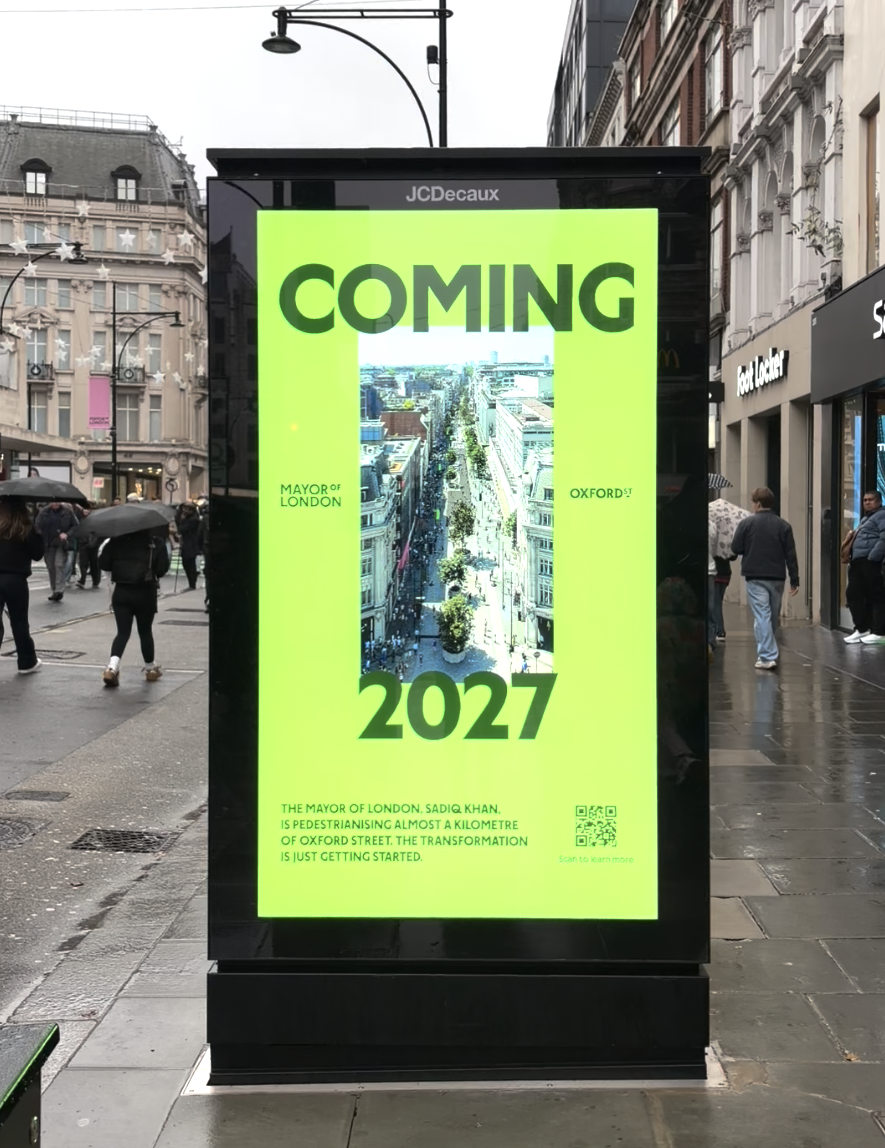
While construction works are already underway in places, with a poster promising that the street’s transformation is “only getting started”, this does not mean the changes will be permanent.

For now, everything that has been implemented is temporary, allowing data and feedback to be collected on how people use the space before permanent improvements are designed. The finalised new layout is expected to be published by November 2027.
And there is plenty to look forward to. Plans for the area include more than 100 new seats and dining tables, and more than 50 new trees, with two new public squares expected to be in place by the end of spring 2027.
Quite a few new features have also popped up overnight. A bit further down the street, a number of signs explain the past, present and future of Oxford Street, with a fun slogan saying that it was “built by Romans, conquered by pigeons”. Indeed, I learned that Oxford Street has been at the centre of commerce for over 200 years.
There are also new information signs that show exactly where Oxford Street has been pedestrianised and where to catch a bus.

One thing I noticed towards the end of the walkway, at the famous Oxford Circus junction, was the traffic. As cars and buses inched closer to the cordoned-off zone, I could see they were being funnelled by orange cones to squeeze into a side road, with traffic thick and slow.
The rerouting of traffic was one of the key concerns raised by Westminster City Council. It had suggested that traffic being displaced onto surrounding roads could impact air quality, noise, access and public safety.
I also can’t help but wonder how shops will adapt to the new delivery window. According to the official TfL webpage, shops will have to schedule their deliveries to arrive between midnight and 7am. How smoothly that works is likely to be the real test of the scheme’s first winter, especially as Christmas approaches.
In principle, many of the big retailers are behind the scheme, with both Selfridges and John Lewis having previously voiced support for the transformation plans.

This was also echoed by New West End Company’s Chief Executive, Dee Corsi, who commented: “The pedestrianisation of Oxford Street presents a major opportunity to transform the visitor experience and attract more people to the West End.”
Although she also noted the importance of getting the practicalities right. “As businesses enter the crucial Christmas trading period, the focus must now be on getting the delivery right and ensuring that Oxford Street thrives as the nation’s high street,” Corsi noted.
“West End businesses are deeply invested in the project’s success, and the priorities are clear – ensuring the street is safe, clean, accessible and welcoming, while getting the practical details right.”
From my perspective, walking up and down the entire stretch on Monday afternoon, the thing that struck me most was how quickly people got used to it. Everyone was immediately comfortable taking over the entire road, and the atmosphere was very positive despite the rain and cold.
My question is whether there will be any major teething issues for retailers and shops, especially regarding deliveries, and how shoppers will respond once the initial novelty subsides and the Christmas crowds fade. But that is a question the next few months will answer.